The major difference between the blood and chocolate agar lies in how they are prepared in the laboratory. Basically, blood agar is prepared by adding blood to a nutrient agar base. Chocolate agar, on the other hand, is produced by heating the blood agar during preparation.
This difference in preparation (i.e heating) is what determines which of the two contains or those not contain factor V and factor X.
Factor V and X are normal components of red blood cells (RBCs). However, some fastidious bacteria, especially Haemophilus species, need them to be able to grow. Because of this reason, factor V and X are called growth factors.
- Factor V (NAD) is found inside RBCs because red cells need it for their own metabolism to produce energy.
- Factor X (hemin) is part of hemoglobin, the protein in RBCs that carries oxygen. Hemin is the iron-containing portion of the heme molecule.
“The heat treatment of blood in the medium lyses red blood cells, releasing growth factors such as hemin (X factor) and NAD (V factor), which are essential for the growth of certain bacteria.”
TL;DR
Factor V
Factor V and factor X are both largely inside the intact red cells. However, factor V (NAD – nicotinamide adenine dinucleotide) is a small, water-soluble molecule that may leak out in intact RBCs.
So, in blood agar, where we have intact unlysed RBCs, the factor V may be present in small quantities but this quantity is usually not sufficient for the growth of V-dependent organisms.
To get the factor V out, we heat it to convert it to chocolate agar, where the cells are lysed and all factor V erupt.
Factor X
Unlike V, the factor X stays very intact in blood agar. Factor X is tightly bound to the haemoglobin inside the red blood cells. It can only be released when the blood agar is heated, red cells lysed.
It is also called hemin.
As we’ve seen, chocolate agar contains both Factor V and Factor X in sufficient quantity. Hence, it allows the growth of fastidious organisms that require both X and V factors – HAEMOPHILUS INFLUENZAE.
X and V factor Test
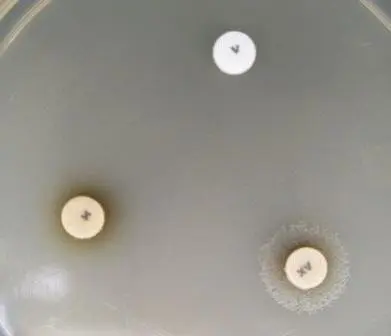
The X and V growth factor requirements of other organisms can be determined using the principles of agar diffusion with paper disks or strips containing X, V and XV factors. Thus, following the principle of agar diffusion, if:
- there’s growth around the XV disk and not the X nor the V disk, the organism is said to be Haemophilus influenzae.
Others are:
| Organism | X factor | V factor |
|---|---|---|
| H. haemolyticus | + | + |
| H. parahaemolyticus | − | + |
| H. parainfluenzae | − | + |
| H. ducreyi | + | − |
| H. aphrophilus | − | − |
NB: Since H. parainfluenzae needs only V factor, it may grow on blood agar.
Can blood agar grow XV-dependent organisms?
So far, the straight answer to that is No.
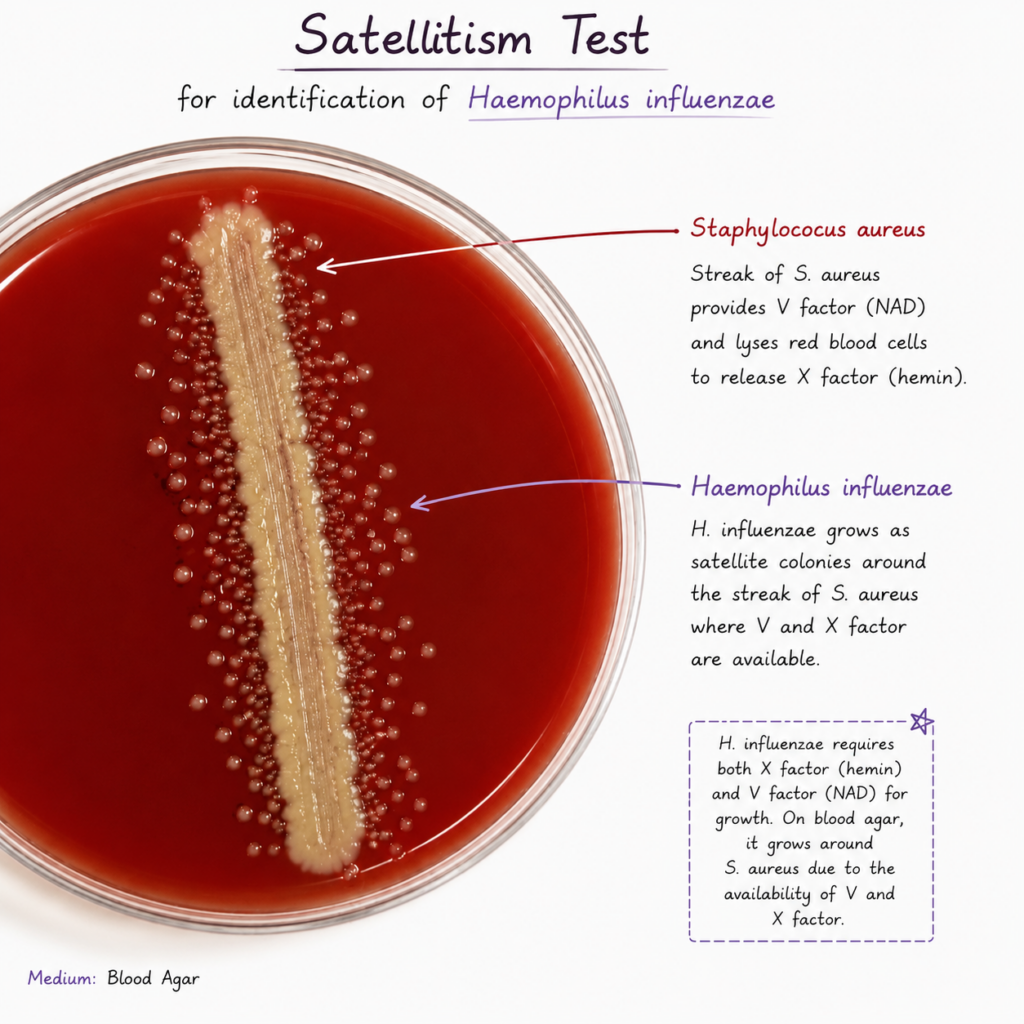
However, H. influenzae can be grown in a blood agar plate previously streaked with beta-haemolytic Staphylococcus aureus. X factor or hemin is provided because the Staph lyses the RBC surrounding its streak.
The Staphylococci aureus species itself produces the V-factor or NAD. These factors allow tiny dew drop colonies of Haemophilus to grow adjacent to the staph streak, a phenomenon called satellitism.