The urea cycle is a series of biochemical reactions that happens primarily in the liver. It is also known as the Krebs-Henseleit cycle or Ornithine cycle.
The urea cycle is the liver’s way of turning toxic ammonia (NH₃) into urea, which is much safer and can be excreted in urine. It simply means we are going from to NH₃ to CO(NH2)2.
The urea cycle begins in the mitochondria of the liver cells and ends in its cytoplasm.Once urea is derived in the liver, it is transported to the kidney through the bloodstream and excreted as urine. You can study the diagram below.
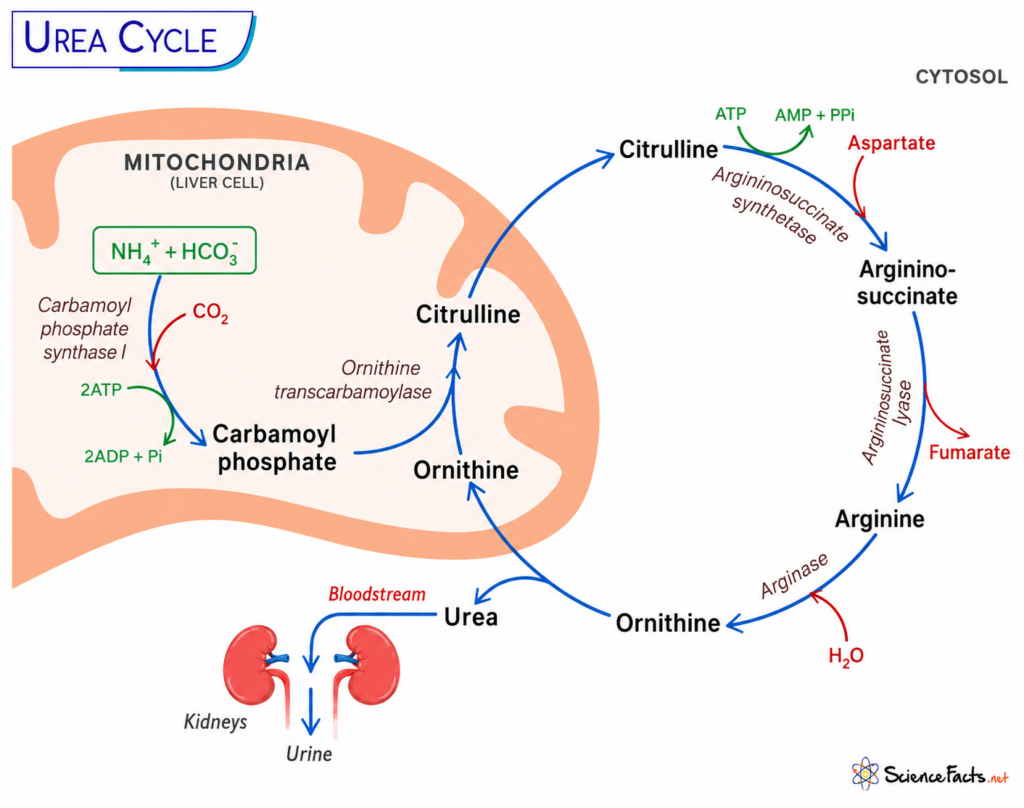
Steps in the Urea Cycle
- The base ammonia combines with Carbon dioxide to form Carbomoyl phosphate. The enzyme here is Carbamoyl phosphate synthase I (CPS I). This step takes place in the mitochodria.
- Also in the mitochondria, the formed carbomoyl phosphate combines with recycled ornithine to produce citruline in the presence of ornithine transcarbamoylase (OTC) enzyme.You’ll learn why ornithine is said to be recycled later.
- Now in the cytosol of the liver, the citruline takes an amino group from aspartate to form Argininosuccinate. The enzyme is of course Argininosuccinate synthetase.
- Argininosuccinate is then broken down to Arginine and Fumarate by Argininosuccinate lyase.
- Arginine is then broken down to Urea and Ornithine in the presence of H20 and Arginase enzyme
– Urea goes to the kidney to be passed out
– Recycled ornithine goes back to the liver to start another cycle.
Urea Cycle: Memory Cues
- These are the 5 molecules you need to first memorize: Ornithine → Citrulline → Argininosuccinate → Arginine → Ornithine
- The final 2 products involves a breakdown.
– Argininosuccinate is broken down to Arginine + Fumarate
– Arginine to Urea + Ornithine - The Ornithine Transcarbamoylase enzyme, from its name, basically combines Ornithine with the Carbamoyl phosphate.
Disorders of the Urea Cycle
Disorders of urea metabolism are commonly due to the defects in the enzymes catalyzing a particular step. These disorders are:
- Carbamoyl phosphate synthetase I (CPS I) deficiency
- Ornithine transcarbamylase (OTC) deficiency
- Argininosuccinate synthetase deficiency
- Arginase deficiency
- Citrullinemia
- Argininosuccinic Aciduria
- N Acetyl Glutamase (NAG) synthetase deficiency: NAG is the obligate activator of CPS I
Relevant Tests in MLS
| Test | What it measures | Typical adult reference value | ↑ Above range — suspect | ↓ Below range — suspect |
|---|---|---|---|---|
| Serum Urea | Concentration of urea in blood | 2.5–7.1 mmol/L | Renal impairment, dehydration, increased protein breakdown — urea accumulates in blood | Severe liver dysfunction, low protein intake, overhydration — decreased urea production or dilution |
| Blood Urea Nitrogen (BUN) | Amount of nitrogen contained in blood urea | 7–20 mg/dL | Renal impairment, dehydration, increased protein breakdown | Severe liver dysfunction, low protein intake, overhydration |
| Plasma Ammonia | Concentration of ammonia in blood | ~15–45 µg/dL (~9–26 µmol/L) | Liver failure or urea-cycle disorder — ammonia is not efficiently converted to urea | Usually not clinically significant |
| Urinary Urea Nitrogen (UUN) | Amount of nitrogen from urea excreted in urine | ~6–17 g/24 h | High protein intake or increased protein breakdown — more nitrogen converted to urea | Low protein intake, severe liver dysfunction or reduced renal excretion |
| Plasma Citrulline | Concentration of citrulline in blood, an intermediate of the urea cycle | ~15–45 µmol/L | Citrullinaemia (argininosuccinate synthetase deficiency) — citrulline accumulates | CPS I or OTC deficiency — impaired formation of citrulline |
NB: Aside Citrulline, Arginine and Ornithine are also plasma amino acids that can be measured in the lab for diagnosis. 1 and 2 are routine in clinical chemistry.